
How I Became a Somatic Practitioner

I want to start with something nobody tells you when you're deep in your healing journey, wondering how on earth to weave all your skills and certifications into something people will actually pay you for. It's simpler than you think.
Not easy, necessarily. But genuinely simple. And the reason most healers don't see that is that they're so deep in their process with themselves and their clients that they rarely zoom out to think about things like long-term professional viability. Trust me, I get it.
The pile of certificates problem
You've done the work. Years of it. You've sat in circles, breathed through things, cried in workshops, and come out the other side changed in ways you can barely articulate. You know how to hold space. You know what nervous system regulation feels like from the inside out. You've probably helped your friends through things that a therapist couldn't crack in two years.
And yet, when someone asks what you do, you either give them a five-minute explanation that leaves them nodding politely, or you shrink and say something like "I do wellness coaching."
This is the certification trap. Most training programs hand you a piece of paper and send you off to explain yourself. You spend your whole marketing life convincing people they need something they've never heard of. It's exhausting, and honestly, it doesn't have to be that way.
Here's what changed everything for me personally:
I stopped trying to explain my modalities and started thinking about what people were already looking for.
Why somatics is different
When I first came across somatic work, I was already running a small coaching practice and teaching yoga. I had clients, but something felt like it was missing. I was helping people think their way through things when what they actually needed was to feel their way through them. I felt like I had to fight for every single client, cycling through building websites, doing new certifications, and building my voice on social media. In hindsight, this was all the wrong stuff to focus on.
When I'd run my coaching sessions, it was clear to me that all my clients had things going on underneath the hood that I couldn't get at. They were suffering in a way that they couldn't acknowledge. I could sense in my body that they needed help, but I didn't have the tools to go there in a way that felt skillful. Doing a somatic practitioner training gave me the skills, the language, and the insights about how to transform stuck trauma in the body.
Somatics is so powerful because it's like a central tool kit of simple observations of how the nervous system heals that you can use no matter what you do. You learn principles like titration, pendulation, window of tolerance, and nervous system imprints. You start to see these everywhere all the time, in yourself and in others. It gives you a toolkit for helping clients take things they normally cycle through and actually work through them. I found myself using all the things I had learned in my yoga, psychology, and embodiment training, but in a more individualized, direct container.
But on a more practical level, the real problem was that nobody was actually searching or demanding the things that I was offering. If nobody is searching for the thing you're offering, that means that you have to sell everything three or four times harder. Of course, you can do that, but it's like climbing uphill.
What I didn't realize at the time was that while I was sitting with this frustration, hundreds of thousands of people every month in the United States were typing the word "somatic" into Google. They were already looking. They already wanted this. They didn't need convincing. Below is a snapshot of how many people every month search for a somatic therapist in the US alone every month.
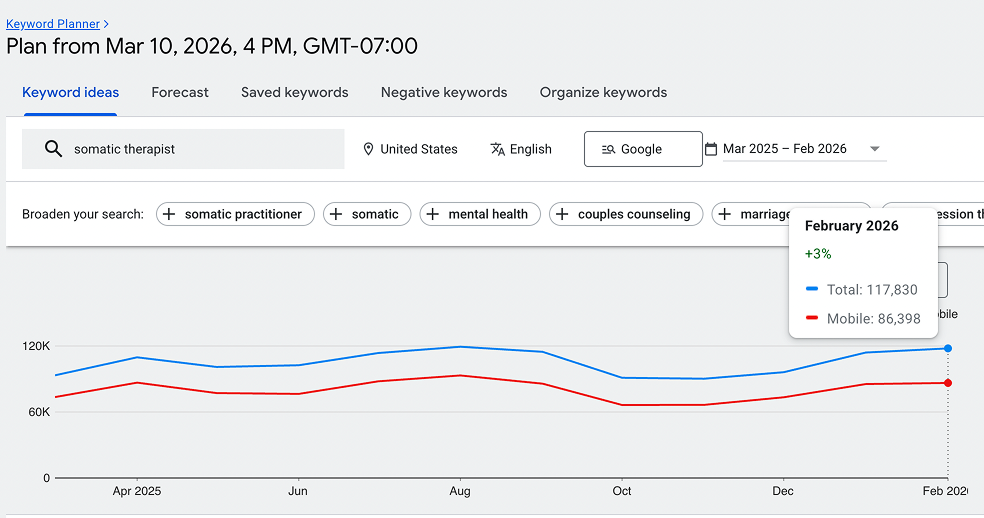
That's not nothing. That's actually everything.
When you build a practice around something people are actively searching for, the energy of your business shifts completely. You're not selling, you're just answering the call for something that’s already in demand. This is what changed everything for me. I stopped having to use my social media and email lists to sell. I just started finding the right people actually looking for my services.
There's a woman out there right now who has tried talk therapy, journaling, three different apps, and two online courses. She knows something isn't working. She's starting to suspect that the answer lives somewhere in her body, not her head. She's looking for someone who can help her get there.
“Somatics allows you to bring together all your various skills as a healer into a clear container that is actually in high demand.”
You are that person. You just need to align your skills with the services this client is looking for, and clients all over the world are flooding into somatics.
The beauty of somatics is that it creates a container for the kind of deep, energetic work you've already been doing in bits and pieces across every modality you've trained in. Yoga, breathwork, trauma-informed coaching, and mindfulness — somatics don't erase any of that. It gives it a home. It gives you a language that people are already speaking.
The business you can start with nothing
I want to be real with you about something: there are very few businesses you can start with zero dollars, from anywhere in the world, and begin practicing almost immediately. A somatic coaching practice is one of them. No studio. No equipment. No inventory. No employees. Just you, your skills, and a willingness to show up. That's a huge advantage, and many people take that for granted.
But because the barrier to entry is low, the difference between people who build something lasting and people who burn out in six months isn't credentials — it's embodiment. It's whether or not you've done your own work deeply enough that clients can actually feel it.
“Starting your own private practice is always a challenge in the first few months, but when you have the right mentoring, it will literally transform your entire life. There's nothing better than getting paid to do what you love and something that transforms people on the deepest level.”
This is where I see people rush, and I understand why. The excitement of a new direction, the hunger to finally have something that makes sense, the pressure of wanting to contribute financially. I rushed too, in my own way. I booked clients before I was ready, and I could feel the difference between sessions where I was fully present and sessions where I was performing presence. Clients feel it too, even when they don't have words for it.
So if you're going to do this — and I think you should — give yourself the gift of doing it right.
What the real work looks like
When I went through my somatic training, the first three months weren't about business at all. They were about me. You don't want to focus on the business right away. This is a huge mistake.
“The difference between somatic training and other trainings is that it holds you to a standard of embodiment. It's not just about becoming a good practitioner; it's about living the principles.”
I was given content, live sessions, guided practices. There were nights I sat with things that had been living in my body for a decade. There were mornings I woke up and felt genuinely different, like something had reorganized itself while I slept. I started to understand somatically — not just intellectually — what I would later offer my clients. This period was challenging, but I had so many breakthroughs, and these breakthroughs are what allow me to now be a great practitioner. This is what Module One in the psychosomatic training is all about.
And then Module 2 came, and it got real.
We started practicing on each other. Two sessions a week, working with fellow students, actually getting into the material with another person's nervous system in the room. This is where things click. It's also where resistance shows up — because real skill development is uncomfortable. There were sessions I left feeling uncertain, feeling like I had more to learn. But that uncertainty was the point. That's exactly where growth lives.
The thing I tell anyone starting out: begin practicing immediately. Not on paying clients, but on your people. Your friends. Your sister. The neighbor who mentioned she's been anxious for months. You will learn more in those informal sessions than in any amount of studying, and you'll start to feel the shift in your own confidence before you ever charge a dollar.
That comfortability you build? It's the whole thing. It's what clients feel when they sit with you. It's what makes someone refer their best friend.
My honest story
I remember the first client who cried in a session with me. Not sad-crying, but release-crying, the kind where something old finally lets go. She looked up afterward and said, "I don't even know what just happened."
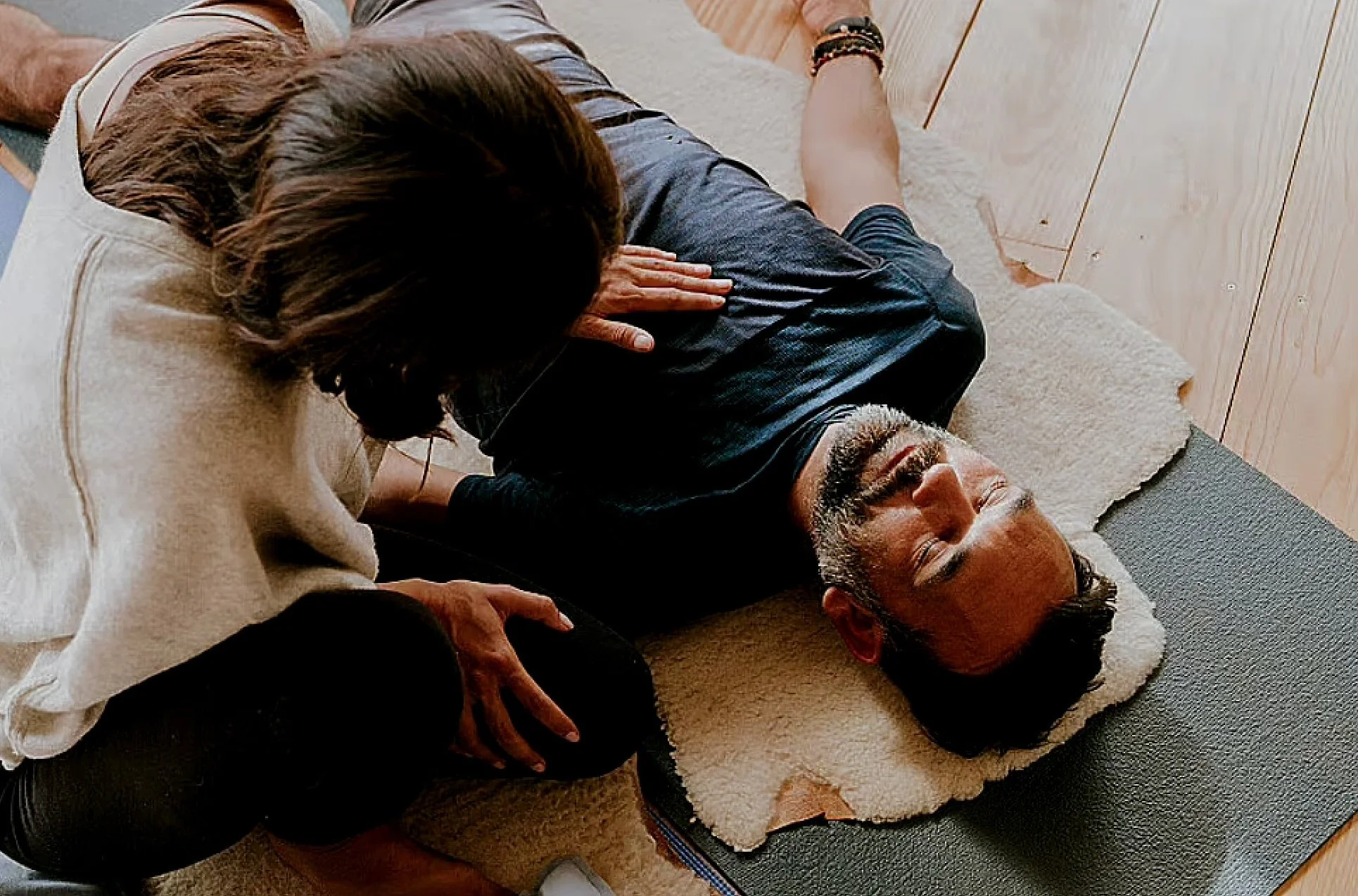
I did, though. And that was the moment I knew this was real.
Before that, I'd been second-guessing myself constantly. Wondering if I was doing enough, saying the right things, using the right techniques. My own therapist had to remind me more than once to get out of my head and into my body — which, frankly, was a little embarrassing given what I was training to do.
But that client? She referred three people to me within a month. Not because I asked her to. Not because I had a brilliant referral strategy. Because her life changed and she wanted that for the people she loved.
I've watched that pattern repeat itself so many times since. When you genuinely transform someone's experience, when they leave a session feeling more like themselves than they have in years, they talk about it. You don't have to be on Instagram every day. You don't have to build a content strategy or run ads. You just have to be good, and be present, and care about the person across from you.
Referrals are not a marketing strategy. They're a byproduct of excellent work. And excellent work starts with your own embodiment.
The only marketing you actually need (at first)
People overcomplicate the launch phase so dramatically that it stops them from launching at all. Let me simplify it.
Connect with someone's pain. Show them you understand what they've been through. That's it.
Not a script. Not a funnel. Not a 30-day content calendar.
When you've been in the room with your own fear and grief and nervous system chaos, you speak about it in a way that people recognize. "I know what it's like to feel like your body is the enemy" lands differently when you mean it in your whole self. That's what draws people to you. That recognition.
You don't have to convince anyone that somatics works. The demand is already there. Your job is just to be present enough that when someone finds you, they trust you.
Yes, you need a website. No, it doesn't need to be complicated.
The question I get more than almost any other is about websites. It trips people up for months. They agonize over branding and colors and the perfect headline and they stall completely.
Here's what I know: you need something that shows you're real and that you know what you're doing. That's the whole job of a beginner's website.
Here’s mine, super simple, straightforward, nothing fancy. https://www.mollie-mendoza.com/
In our program at Integrative Psych, we give students an actual website template. You fill in your information. You get a photo taken somewhere nice. You write three sentences about who you help and what changes for them. Done. Launched.
Could it be better someday? Sure. Build it better later. Right now, credibility matters more than perfection.
This career doesn't have an expiration date
I've watched women in this field build practices that carry them for decades. There's no algorithm change that makes your skills obsolete. There's no market crash that makes people stop wanting to heal. The need for this work is not going anywhere.
But the practitioners who stay, the ones who build something real and lasting, are the ones who went deep first. They did their own work. They practiced before they were ready. They got comfortable with discomfort. They showed up to the hard sessions and they stayed curious.
If you're willing to do that, I promise you: you will have clients. You will have referrals. And years from now, you'll have a career that feels like an extension of who you are rather than something you have to perform.
Become a Somatic Practitioner
Becoming a somatic practitioner takes about five months and can be done completely online. We put new cohorts of between 50 and 100 people through this training every two months. It's $4,000, and I know that can sound like a lot up front, but that's about 20 to 30 clients. This is one of the best investments that you can ever make in yourself.
Every week, we hold a free info call for women who want to learn more about our Somatic Practitioner Training at the Integrative Psychology Institute. If any of this resonated — if you've been sitting on a pile of skills wondering how to make them work — come and listen. Ask questions. Meet the community.
Molly Mendoza is a somatic practitioner and co-founder of the Integrative Psychology Institute.